Vibe Coder · Unit 19: Fine-Tuning a Model · Lesson 1 of 4
When to fine-tune
Fine-tuning changes the model itself. It is the last thing to try, after a better prompt and after retrieval. What it is good for, and what it cannot do.
Read the short notes and pictures.Do everything inside a blue frame.
A tempting shortcut that is not one
"We should fine-tune a model on our data" is one of the most common things said in product meetings, and it is usually the wrong next step. Fine-tuning is real, useful and now within reach of a single person. It is also slower, costlier and harder to undo than the alternatives, and it does not do what most people hope.
The ladder
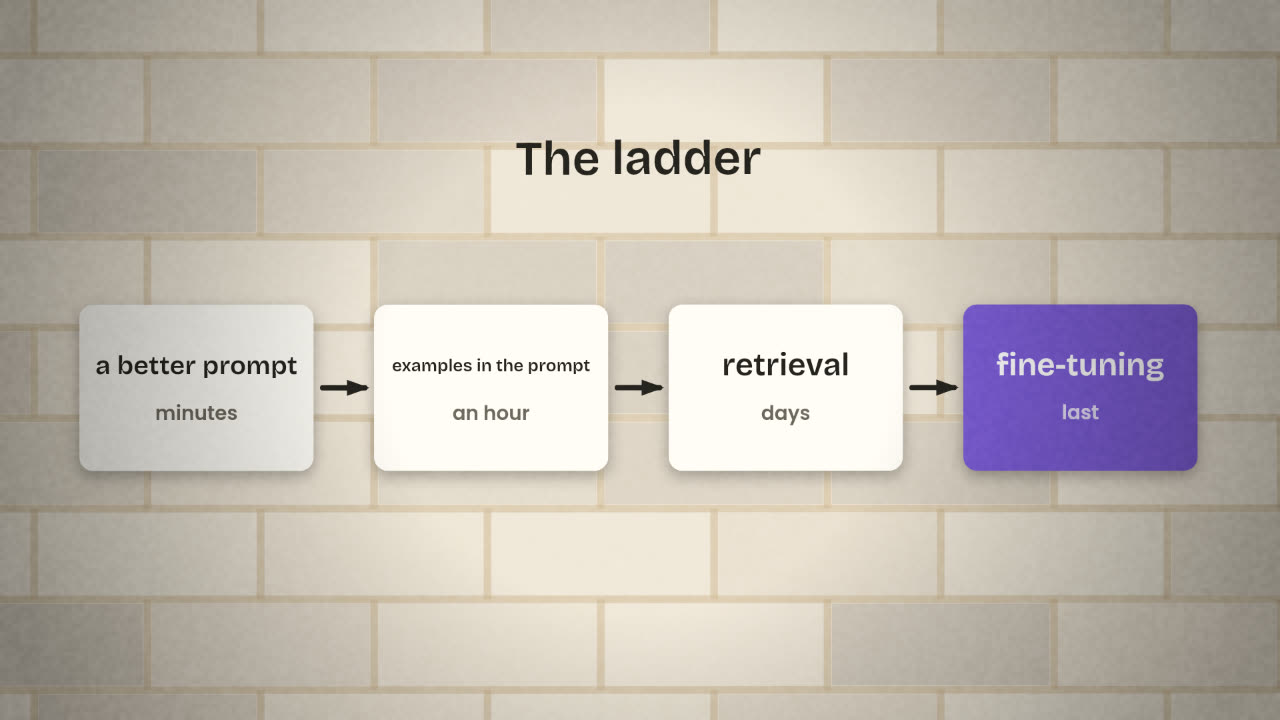
A better prompt
Clear instructions, the material, what done looks like. Costs minutes. Fixes most problems.
Examples in the prompt
Three to ten good input and output pairs. Often enough to fix style and format.
Retrieval
When the model lacks knowledge. This was the last unit.
Fine-tuning
When you have done all three and the behaviour is still not reliable, or the prompt has grown so long that it is slow and costly.
What fine-tuning is
A model is a very large set of numbers, its weights. Fine-tuning continues the training process on your own examples, nudging those weights so that the behaviour you showed becomes the default. Afterwards you do not need to explain the task in every prompt; the model simply does it that way.
Good: style
Replies that sound like your brand without a page of instructions.
Good: format
Output that always fits your structure.
Good: one narrow task
Classifying tickets, extracting fields, rewriting to a house style.
Good: smaller and cheaper
A small tuned model can match a large general one on a narrow task, at lower cost per call.
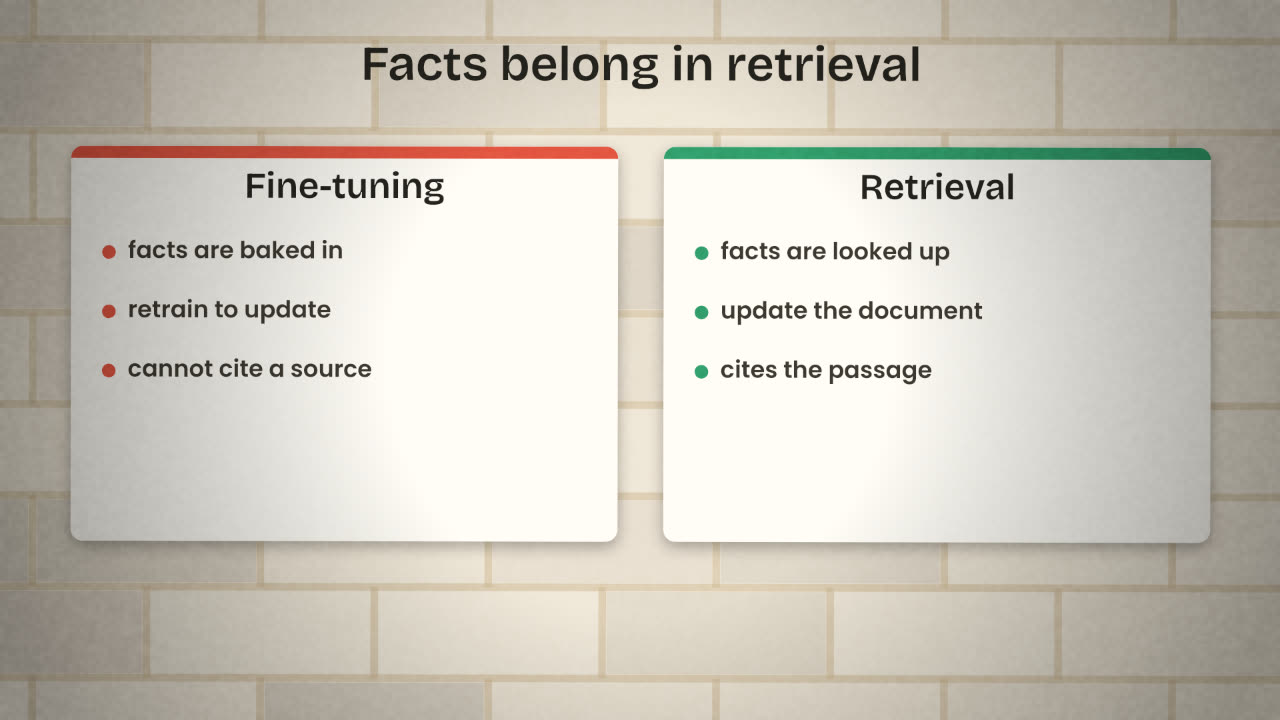
Bad: facts
Trained-in facts go stale, cannot be cited, and get blended with what the model already believed.
Bad: small data
A handful of examples will not move a model in a useful way.
Bad: fixing a vague task
If you cannot write down what good looks like, training will not find it for you.
LoRA
Retraining every weight of a large model needs a lot of hardware. LoRA, low-rank adaptation, trains a small set of extra weights instead and leaves the original model as it is. The result is a small adapter file. You met the same idea for image models. QLoRA goes further by working on a compressed copy of the model so it fits on smaller graphics cards.
For each of these, say which rung of the ladder you would try first: (a) the helper does not know your refund policy; (b) replies are correct but too long and formal; (c) you classify 50,000 tickets a day with a long prompt and the bill is high.
Decide whether your product needs fine-tuning
Pick the one task in your product that a model does most often. Write down what you have already tried on the ladder and how well it works, using real examples. Decide: no need, or worth an experiment. Either way, continue the unit to learn the method on a small task.
Done when
The ten examples are the start of your dataset.
Keep these
- Prompt, then examples, then retrieval, then fine-tuning.
- Fine-tuning teaches form: style, format, a narrow task.
- LoRA trains a small adapter and leaves the base model unchanged.